What cashing up is
Cashing up, or reconciling the till, is the check you do at the end of every shift to confirm the money matches the sales. It is not about distrusting your team: it is how you catch wrong change, a card payment keyed in as cash or a transfer that never arrived, while you can still find out why.
The basic rule: one cash-up per till, per shift, done by the person who ran that till. If two people share a drawer without cashing up in between, any difference has no owner.
The float: your starting point
The float is the cash the till starts with so you can give change. It is not takings: it starts and ends the shift at the same amount.
- Use the same amount every day, so anyone can spot when something is missing.
- Make it up of coins and small notes.
- Count it when you open and write it down with the signature of whoever opened: if it doesn't match what the last cash-up left, the problem lies in that cash-up.
- At close, take the float out before you work out the takings and leave it ready for the next shift.
What to record during the shift
A good cash-up is prepared during service. Anything not written down at the time becomes an unexplained difference at the end.
- Every sale with the payment method actually used. A card payment keyed in as cash throws out two methods at once.
- Paid-outs: cash taken from the till to buy milk from the corner shop or pay the window cleaner, always with a receipt or a signed slip in the drawer.
- Cash added that isn't a sale, such as extra coins put in mid-shift for change.
- Voids and refunds, with the reason and who authorised them.
- Tips, kept apart from the sale and with the method they were paid by.
Cashing up step by step, method by method
- Stop taking payments on that till and pull the shift summary by payment method from your system: cash, card, bank transfer and other.
- Run the end-of-day report on the card machine.
- Count the cash, work out the expected figure for each method and write the differences on the sheet.
- Take out the float for the next shift, bank the rest or put it in the safe, and sign the sheet. File it with the card machine report and the paid-out receipts.
Cash
First work out what should be in the drawer: expected cash = opening float + cash sales + cash added − paid-outs. Then count notes and coins by denomination, without interruptions, and write down the total. The difference is counted minus expected: a positive figure is an over, a negative one a short.
Card
Card money isn't in the drawer, so you compare the card total in your system with the card machine's end-of-day report.
X report vs Z report
On many tills and terminals the end-of-day report is the Z report, which closes the day and resets the totals; an X report shows the running totals without resetting them. The names vary by provider. If tips are added on the card machine with the bill, the report shows both together, so compare it with card sales plus card tips.
Watch the timing: if your card machine banks automatically at a set time and your shift ends later, its report will span two shifts. Check how yours works and always use the same cut-off.
Bank transfers
If you take bank transfers, check in your banking app that each one you recorded actually arrived, for the right amount. A screenshot of a payment is not money in your account: count it as paid once you can see it received.
Keep tips separate
Keep tips out of your sales figures, so you know what the business took and what you owe each person. They don't go into the day's sales and, ideally, don't mix with the till cash either.
- If cash tips go into a separate tips jar or envelope, leave them out of the expected figure: count them on their own and write them down.
- If they stay in the same drawer, add them to expected cash and take them out at close as a separate line, ready to hand over or share out.
- Tips paid by card or transfer arrive together with the sale: record them so you know what you owe each person.
Record every tip payout with the date, the amount and who received it, whether tips go to whoever served the table or are pooled across the team.
Overs and shorts: what to do
A difference isn't fixed: it is explained and recorded. Before you accept it, check in this order:
- Count the cash again.
- Look for payments keyed in with the wrong method: a card payment recorded as cash creates a cash short and a card over of the same amount.
- Check the paid-out receipts and the voids for the shift.
- If the card total doesn't match, compare the payments one by one with the card machine's transaction list.
- If the difference is still there, write it down with an explanation, signed by whoever cashed up and the manager.
An over is a problem too: it usually means change that wasn't given or a sale that wasn't recorded. Don't use it to cover another shift's short or move it into tips. Decide the amount above which a difference is reviewed with the manager, and track differences week by week: if they keep appearing on the same shift, person or method, that is where the cause lies.
Who cashes up and who signs?
Ideally two people: the person who ran the till counts and signs, and a manager or the owner checks and signs as well. If there is no second person, take a photo of the sheet and the counted cash and send it to the owner. If the cashier changes mid-day, close the till and open a new one.
Free cash-up sheet template (Excel and PDF)
Download the sheet as an Excel file, with the sums already in and a worked example, or as a printable PDF on A4. Both are free, with no sign-up.
Use one sheet per till, per shift. At the top, write the date, the shift, the till, who opened and who closed. If you would rather build your own, it is two tables: the cash count, and the reconciliation by payment method.
Cash count by denomination
| Notes and coins | How many | Value |
|---|---|---|
| £50 notes | £ | |
| £20 notes | £ | |
| £10 notes | £ | |
| £5 notes | £ | |
| £2 coins | £ | |
| £1 coins | £ | |
| 50p | £ | |
| 20p | £ | |
| 10p | £ | |
| 5p | £ | |
| 2p | £ | |
| 1p | £ | |
| Total counted | £ |
Reconciliation by payment method
| Line | Cash | Card | Bank transfer | Other |
|---|---|---|---|---|
| Opening float | £ | — | — | — |
| Sales according to the system | £ | £ | £ | £ |
| Cash added that isn't a sale (+) | £ | — | — | — |
| Paid-outs with receipt (−) | £ | — | — | — |
| Tips taken by this method (+) | Only if they stay in the drawer | £ | £ | £ |
| Expected | £ | £ | £ | £ |
| Counted, card machine report or bank | £ | £ | £ | £ |
| Difference (counted − expected) | £ | £ | £ | £ |
Underneath, three more lines: cash tips counted separately, an explanation for each difference, and the signatures of whoever cashed up and whoever checked.
A worked cash-up example
A made-up example to show the sheet in use: an evening shift with a £150 float. Cash tips go into a separate jar, so they never enter the drawer, and no bank transfers were taken.
| Line | Cash | Card |
|---|---|---|
| Opening float | £150.00 | — |
| Sales according to the system | £612.40 | £1,486.00 |
| Paid-outs with receipt (milk and lemons) | −£18.50 | — |
| Tips taken by this method | — | £128.60 |
| Expected | £743.90 | £1,614.60 |
| Counted / card machine Z report | £738.90 | £1,614.60 |
| Difference | −£5.00 | £0.00 |
Card balances. Cash is £5.00 short: count again, check the paid-out receipts and the cash payments and, if it doesn't turn up, record it as a short with an explanation. Sales for the shift come to £2,098.40, excluding tips. Tips total £174.60: £46.00 from the jar and £128.60 on card. That leaves £738.90 − £150.00 = £588.90 to bank, and the £150.00 stays as tomorrow's float.
How ElMenu does it
With the ElMenu till, on the Professional and Premium plans, you open the till with its opening float and every payment is recorded with its method: cash, card, bank transfer or other (card payments are still taken on your own card machine).
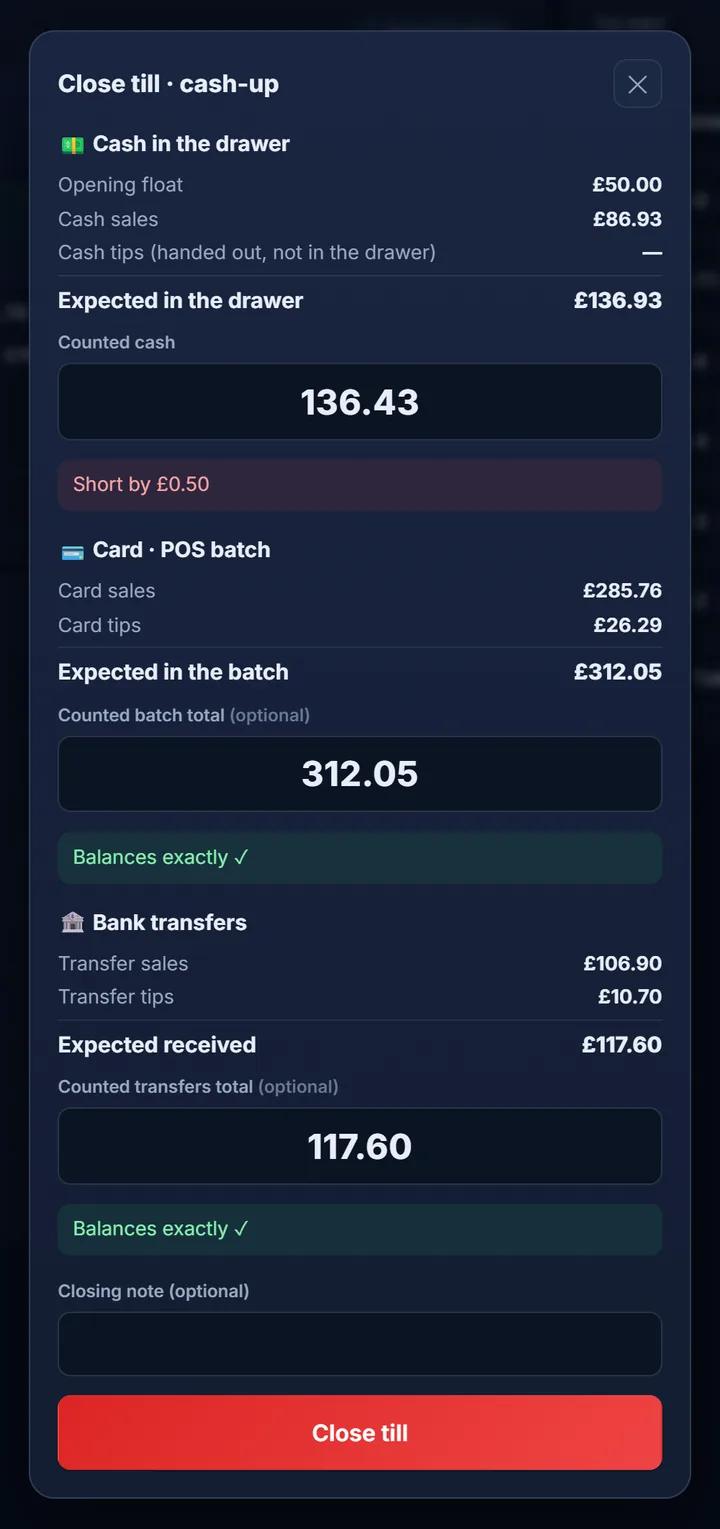
When you close the till, the screen shows the cash breakdown (float, cash sales and, if you set it up that way, the cash tips that stay in the drawer) and the expected cash. The cashier enters what they counted and sees straight away whether it balances, is over or is short. With card and transfer reconciliation on (it comes that way), they also enter the card machine batch total and the transfers received, and ElMenu works out those differences too. Tips are kept apart from sales.
Every cash-up is saved with who opened and who closed the till, and in Till Reports you can download your cash-ups as a CSV file for Excel. One thing to know: the ElMenu till doesn't log paid-outs, so if you pay for something from the drawer, keep the receipt in the drawer and write it on your sheet to explain the difference. See what each plan includes on our pricing page.